Military education
Use structured scenarios to teach doctrine, historical comparison and critical challenge.
Frame the scenario. Test the approach against a curated corpus spanning 1014–2025. Surface doctrinal matches, historical analogues and explicit risk conditions before commitment.
Decision support, not command authority. The analyst judges.

01 // Intended users
SCUL is for professional military educators, war-studies researchers, geopolitical-risk analysts and institutional decision-makers who need a structured way to challenge assumptions and document analytical judgement.
Use structured scenarios to teach doctrine, historical comparison and critical challenge.
Make assumptions, constraints and historical comparisons visible to clients and review teams.
Create an auditable analytical starting point before expert judgement and formal review.
Scope boundary: SCUL is not an operational command system, intelligence feed or autonomous battle-planning tool. It is decision support; accountable people remain responsible for every judgement.
02 // Decision architecture
SCUL turns a complex strategic problem into a disciplined analytical sequence—without pretending that software can replace accountable human judgement.
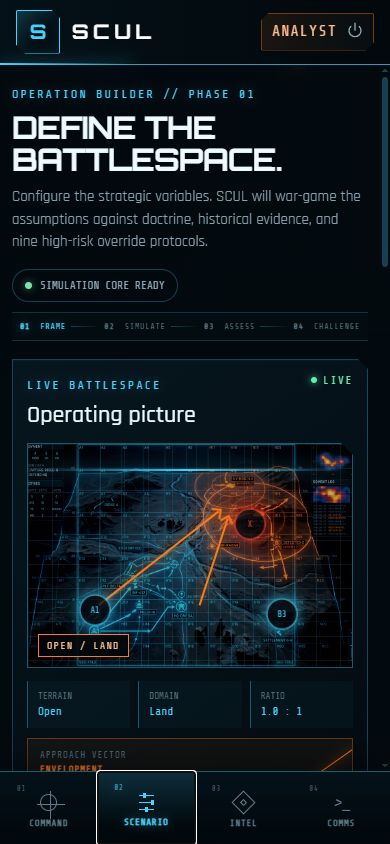
Capture the objective, actors, terrain, time horizon, constraints, force ratio and strategic approach in one structured workspace.
Pattern-match the scenario against a curated body of doctrine and historical engagements spanning classical to contemporary conflict.
Nine explicit risk conditions flag recurring patterns associated with strategic failure in the curated sample.
03 // Worked assessment
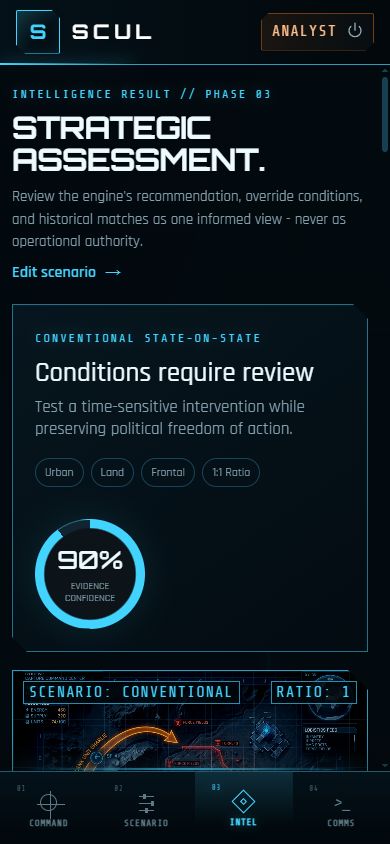
This fictional regression scenario demonstrates what SCUL does: it turns stated assumptions into visible risk conditions, historical comparisons and questions for further review.
A planning cell proposes a second frontal axis with a 1.6:1 force ratio, a 600 km supply line, assumed air superiority and no dedicated logistics or information line.
What SCUL recommends next: revisit the inputs before course-of-action development, inspect the closest analogues and test whether the constraints invalidate the proposed approach.
Illustrative output from a fictional scenario. Historical similarity does not establish causation or predict an outcome.
04 // The operating picture
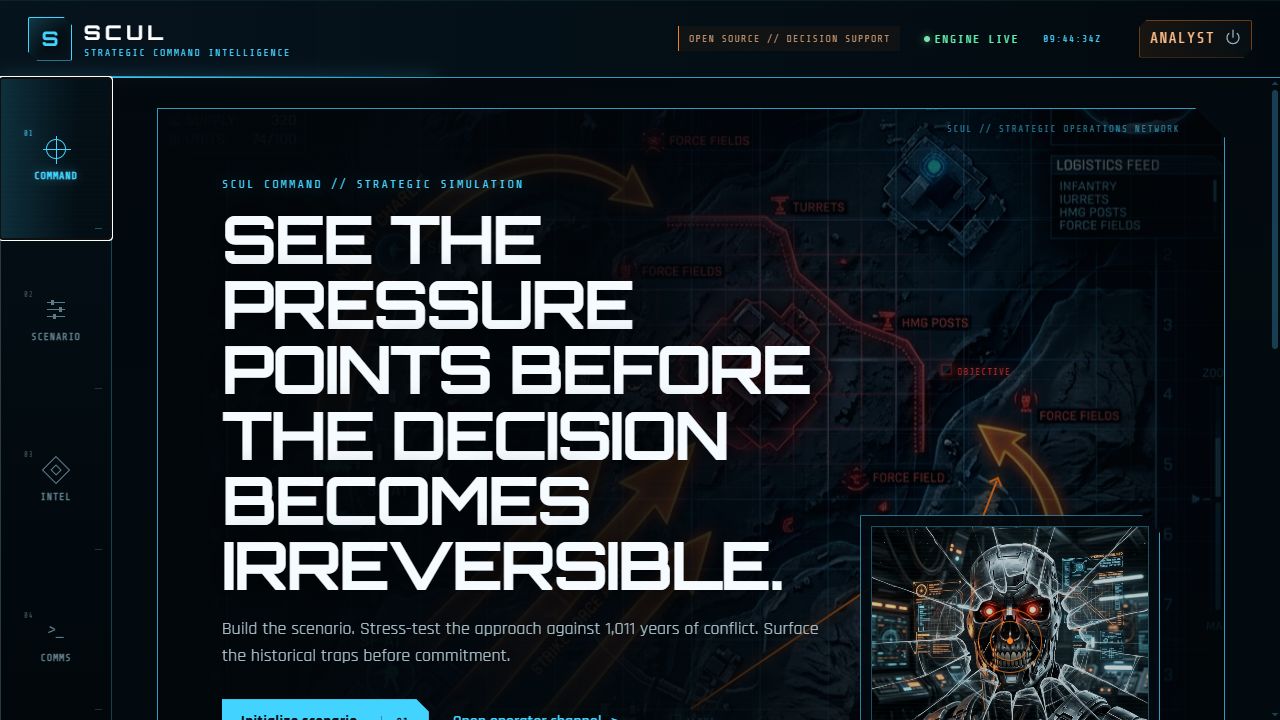
Every result keeps the evidence visible. Review matched doctrine, examine historical parallels, inspect triggered conditions and decide what deserves further scrutiny.
05 // Methodology and limits
SCUL’s deterministic engine pattern-matches structured inputs against a bounded, hand-curated corpus. It does not learn from users, consume live intelligence or predict outcomes.
The 137 engagements are a curated sample, not a census. Entries were selected for analytical contrast across periods, domains, terrain and approaches, subject to the availability and quality of records.
Survivorship, reporting, canonical-source and coding bias remain possible. Historical analogues are prompts for investigation, not proof that two situations are equivalent.
The nine conditions encode recurring failure patterns. They are explicit, inspectable heuristics—not universal laws—and should be challenged when context differs.
The engine has deterministic regression tests and worked scenarios. It has not yet undergone independent academic validation or a published out-of-sample study.
Repeated irrelevant analogues, material rule false-positives, expert reviewers unable to reproduce the reasoning, or out-of-sample cases that consistently contradict the surfaced pattern are reasons to revise the method.
06 // Evidence before confidence
“The system should sharpen the analyst’s judgement—not conceal uncertainty behind a confident answer.”
SCUL is built around traceability. Its recommendations remain tied to visible doctrine, historical parallels and explicit rule conditions.
07 // Access plans
Payments are being finalised. Early accounts are currently enabled manually, with plan pricing confirmed before activation.
Review the worked example and evaluate the structured methodology.
For individual analysts, educators and researchers using custom scenarios.
For teams requiring onboarding, governance review and agreed access controls.
ZAR and USD monthly and annual pricing will be published when payment processing is enabled. No payment is requested during manual evaluation.
08 // Data and governance FAQ
No. The deterministic engine uses structured inputs and a curated historical and doctrinal corpus. Status labels do not imply a live intelligence feed.
When you run an assessment, the structured fields are sent through an authenticated Firebase function. The server checks account access and applies the deterministic rules against the protected corpus; the current function returns the result without intentionally saving the scenario to your profile. Refer to the privacy policy for current processing and retention details.
Your question and relevant analytical context are sent through an authenticated SCUL server function to Google Gemini. The API credential is held server-side, and inactive accounts are rejected by the server.
No. Outputs are prompts for structured scrutiny. They require corroboration, contextual expertise and accountable human judgement.
SCUL Systems is based in South Africa and describes its processing, providers, retention and user rights in its POPIA-aware privacy policy.
09 // Mobile deployment
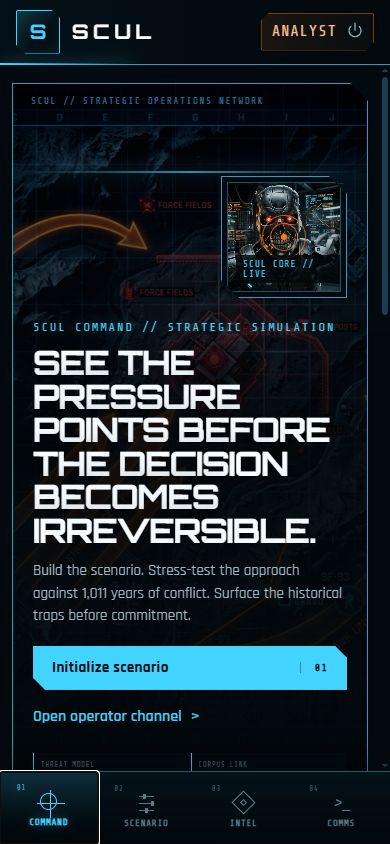
The SCUL web app is available now. Native Android and iPhone editions are being prepared for their respective app stores.

SCUL // Web app available
Start in the web app today, or contact the SCUL team for access and product enquiries.